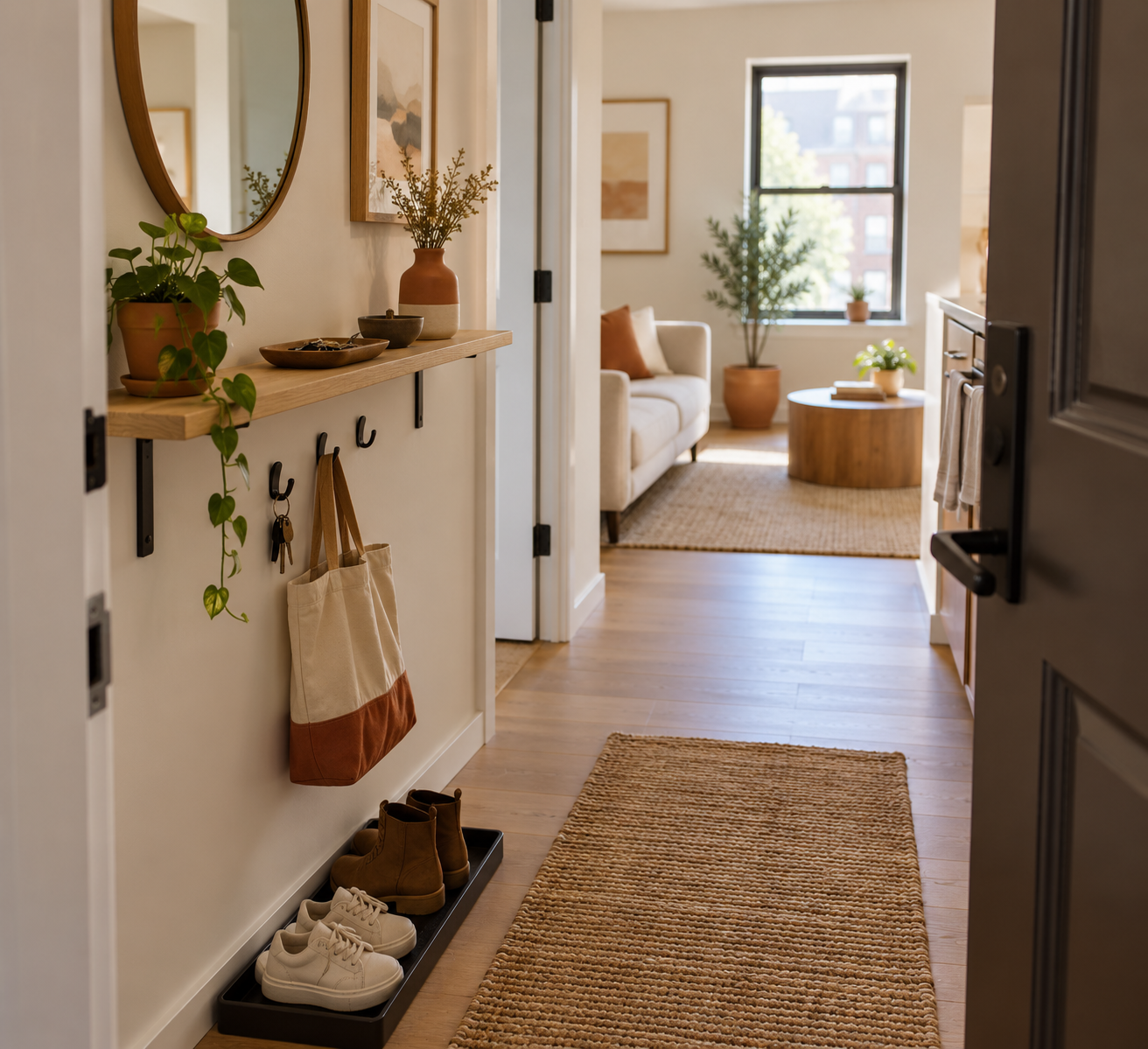
You can create a useful landing spot without fitting a console table beside the door. Focus on the belongings that arrive with you, the path through the space, and a routine for putting things away.
1. Map the way you enter
Open the front door fully and look at where you naturally step, put down a bag, and take off shoes. Keep the door swing and walking route clear. Include the needs of anyone using a stroller, mobility aid, or bulky work bag.
Do not begin with a furniture purchase. First identify the actual problem: lost keys, too many shoes, incoming mail, or coats with nowhere to go. A solution for one problem does not need to become a full entryway set.
2. Create a small home for keys
Use a shallow tray on an existing nearby surface if one is available. Place it where it is easy to reach when arriving and leaving, but not somewhere visible from outside. A single consistent spot is more useful than several decorative bowls.
If a shelf would help, measure its projection into the passage and the door clearance. Check the wall construction, installation instructions, lease rules, and load limits before fitting it. Decorative shelves should not become supports for heavy bags.
3. Limit the shoe zone
Choose a designated spot for the pairs used most often. A shallow tray can contain daily shoes without turning the entire entrance into shoe storage. Move occasional pairs to another suitable location.
Avoid stacks that can topple into the passage. If you add a rack, check its depth with shoes actually on it, not just its empty dimensions. Keep the area workable when the door is open and when people pass each other.
4. Handle coats and bags deliberately
A nearby closet may be a better place for coats than an overloaded row of hooks. If hooks are appropriate, position them for the users and follow the mounting guidance. Adhesive products have surface, weight, and removal requirements; they are not automatically damage-free.
Assign a hook or storage section to each regular user if that simplifies the routine. Store extra bags elsewhere. Keep straps out of the walking route, especially where they could snag a door or another person.
5. Prevent a paper pile
Designate one small inbox for incoming papers. Review it regularly, separating documents to keep from items to recycle. Use a separate secure place for papers containing personal information.
Before bed or when you next leave, return shoes and bags to their assigned spots. A compact entryway works best when it holds what is needed now, rather than becoming storage for everything waiting to go somewhere else.
Your practical checklist
- Check the full door swing.
- Keep a clear walking route.
- Choose one consistent key spot.
- Keep only regular-use shoes at the entrance.
- Check mounting and lease requirements.
- Review incoming papers before they accumulate.